


From the CEO's Desk
Where Onflo Is Heading: Four Principles Behind Our Latest Release
Dear District Partner,
For over a dozen years, I have had the incredible privilege of averaging one deep dive with a school district every week. That has given me an unusually close vantage point on district technology stacks and on how schools use those tools to deliver customer service.
Districts have added ticketing, work orders, phone systems, form tools, workflow tools and other point solutions to solve real problems. But taken together, the tools meant to make work easier have increasingly become work themselves. They have to be implemented, learned, supported, integrated, upgraded and paid for, creating a layer of bureaucracy that is exhausting to manage.
I am particularly excited about our latest Onflo release because it takes a major step toward reducing the sprawl of tools, complexity and cost that districts have accumulated over time.
One platform, without forcing everyone to work the same way
IT is different from Maintenance and Facilities and Transportation is different from HR. Each needs its own workflows, queues, permissions, SLAs and dashboards. A unified platform should not erase those differences.
With Onflo Modules, departments can operate independently while sharing the foundation that should be common across the district: one authoritative listing of buildings and rooms, staff, student and parent identities, and integrations with other systems of record. That information can be defined once, governed appropriately and kept synchronized with the systems the district already trusts, including the SIS, identity management and MDM.
Think about installing a classroom display. IT may own the technology and Facilities the installation, but the platform should let them coordinate tasks across departments without either team giving up control of its own process. If it is purely an IT issue, Facilities should never need to see it.
Centralize the foundation. Preserve departmental control.
Automation and AI should remove work
Districts face rising expectations from parents, teachers, staff and students while working with tighter budgets and fewer people. There is a limit to how far we can take “do more with less” by simply asking people to work harder.
The next gains have to come from eliminating work.
Our workflow and AI capabilities can identify critical issues, surface outages and relevant knowledge, recognize duplicate requests and help route work. Flo, our AI Phone Agent can handle inbound interactions around the clock. Our expanded workflow engine can manage approvals, tasks, reminders, escalations and more complex processes using district information such as role and location.
The human operator remains in charge. Districts should determine where automation is appropriate, where review is required and what AI is permitted to do. The work should remain visible and auditable.
The economics matter
There is also a straightforward financial argument. The cost of another point solution is never just its license. It is another implementation, integration, training program, support burden, upgrade cycle and renewal.
A common platform should reduce that overhead, and its pricing should remain understandable as a district expands its use. Customers should not have to renegotiate the relationship every time another department finds value in the platform.
Where this is heading
For us, the direction comes down to four things:
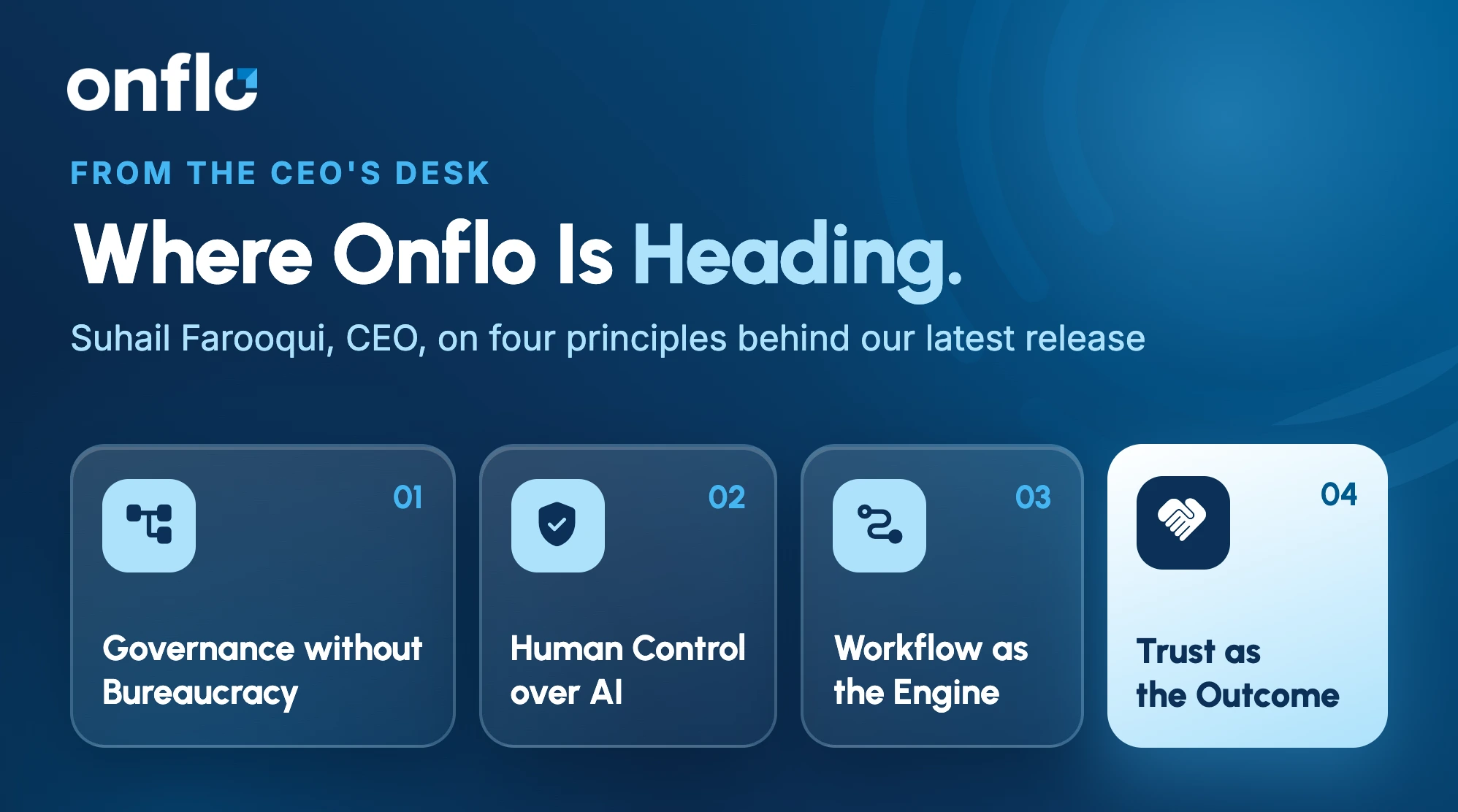
- Governance without bureaucracy. Manage shared infrastructure centrally while giving departments control of their own operations.
- Human control over AI. Automate aggressively where it helps, but let districts determine the boundaries.
- Workflow as the engine. Move work across people, systems and departments without requiring someone to manually push every step.
- Trust as the outcome. People should know where to go for help, who owns the issue, what is happening and whether the district will follow through.
Efficiency matters. So does the experience of the person asking for help. Increasingly, I think the best technology will be the technology they barely have to think about.
As always, I’m looking for more deep dives. If this sparks even one idea you’d like to share, or if I can be a sounding board for something you’re working through, it would be an honor. Just hit reply.
In the meantime, my continued best wishes for a successful school year.
Suhail
CEO, Onflo
